

Please select your location and preferred language where available.
KIOXIA Super High IOPS SSD Accelerating the AI Revolution!


April 14, 2026
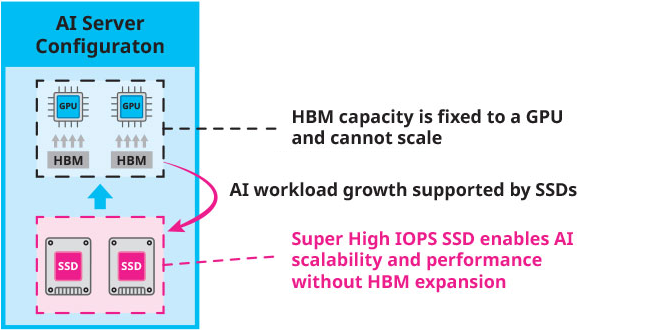
Modern AI is dominated by generative AI, which refers to programs that leverage large language models (LLMs) to automate intellectual processes typically performed by humans. AI and GPU-centric applications leverage High Bandwidth Memory (HBM) to provide a fast connection between the GPU and frequently accessed data, such as model weights, LLM Key/Value (KV) Cache, and other application-specific time-critical information. For a given deployment, the amount of available HBM capacity is directly tied to the ability to support competing priorities, such as the size of the models that can be hosted, the length of the context windows that a model can operate on, or the number of users that can be supported simultaneously. Given the growth trajectory for GPU and AI applications over the foreseeable future – and given the central role that HBM plays in modern AI/GPU pipelines – requirements on HBM capacity will only increase over time. Unfortunately, direct expansion of HBM, such as memory expansion and increasing bandwidth etc., runs into practical cost and scalability issues that compels the need for new technologies to offset these difficulties.
KIOXIA Innovation: Next-Generation SSD Solutions for GPU and AI Applications
KIOXIA realizes the opportunity for SSDs to help GPU and AI applications struggling with these HBM capacity pressures. Open-source initiatives such as Big Accelerator Memory (BaM) have opened an alternative expansion pathway to allow direct data access between GPUs and SSDs, paving the way for speed-of-GPU data movement. From a storage perspective, keeping pace with the GPU to take full advantage of this new capability requires an SSD purpose-built for extreme IOPS at low block sizes at levels never-before seen on a single drive. The number of input/output operations per second (IOPS) indicates the speed of random read and write operations and serves as a benchmark for the performance of storage devices.
Super High IOPS SSD Unveiled at FMS 2025
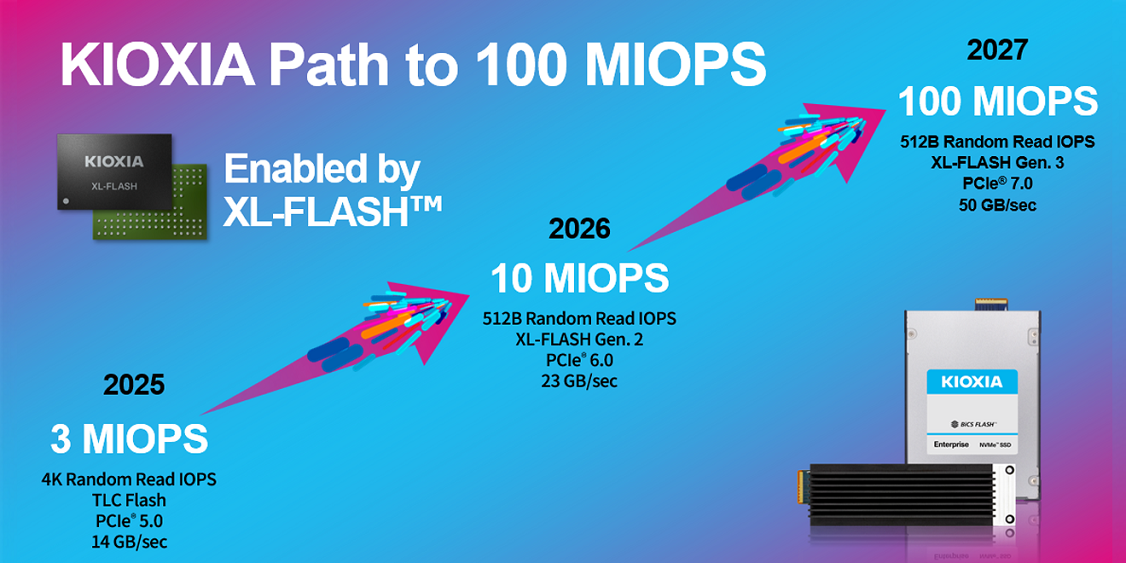
During the keynote address of the Future of Memory and Storage 2025 conference in Santa Clara, California, KIOXIA was excited to announce an upcoming Super High IOPS SSD, capable of achieving a staggering 100 MIOPS (million IOPS) of 512 byte random read operations. KIOXIA presented benchmarks of the emulated Super High IOPS SSD, which established the capability of exercising the BaM framework against a target device capable of hitting the 100 MIOPS goal, ultimately intended for productization. This performance point allows SSDs to step in and shoulder some of the burden that HBM has historically been responsible for, thereby enabling solution structures that can take advantage of an effectively larger pool of high-performance GPU-facing memory. In addition, there is an industry effort to advance BaM and rapidly progressing development of a solution utilizing NVMe™ SSDs in GPU I/O, called "NVIDIA Storage-Next™." KIOXIA is working to develop SSDs that align with the NVIDIA Storage-Next initiative.
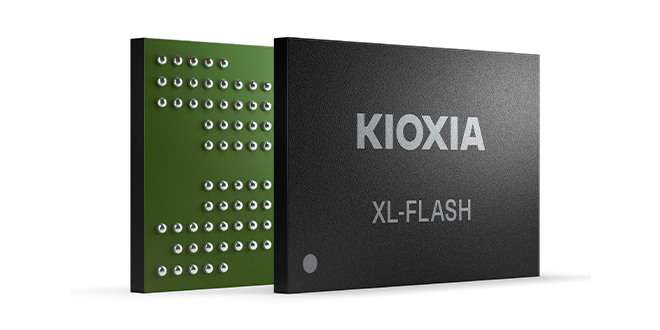
Recognizing the growing demand for a flexible and affordable Storage Class Memory (SCM) solution, KIOXIA developed XL-FLASH, an extremely low-latency, high-performance flash memory. XL-FLASH is designed to address the performance gap that currently exists between volatile memories such as DRAM and current flash memory.
Examining the Enormous Figure of 100 MIOPS
Typical high-performance NVMe SSDs for consumers achieve hundreds of thousands of IOPS. Even high-end SSDs for data centers reach only about 6 MIOPS, which illustrates just how extraordinary the figure of 100 million is.
So why is such performance necessary right now? The reason lies in AI, particularly in the workloads associated with the inference phase. During this phase, tasks like image recognition and text generation are performed using trained models. This requires rapidly accessing a vast number of small pieces of data from large datasets in an unpredictable order.
Data storage and memory technologies are becoming increasingly important for the advancement of generative AI. Kioxia has a long-term commitment to advancing AI through research and development of high-capacity storage such as SSDs and flash memory that are essential for AI systems, and innovative open-source technologies like KIOXIA AiSAQ™.
Reducing the GPU Starvation Problem
What is crucial here is not the sequential performance of reading large files, but the speed of random access. In other words, IOPS directly impacts the responsiveness of the system. Modern AI servers are equipped with numerous expensive GPUs, but if the storage delivering data is slow, performance cannot be fully realized. This situation is known as "GPU starvation," which can severely reduce the efficiency of the entire AI infrastructure. KIOXIA SSDs capable of achieving 100 MIOPS are a vital solution to alleviate this GPU starvation and unlock the potential of AI systems.
Next-Generation SSDs Delivering Extreme Performance
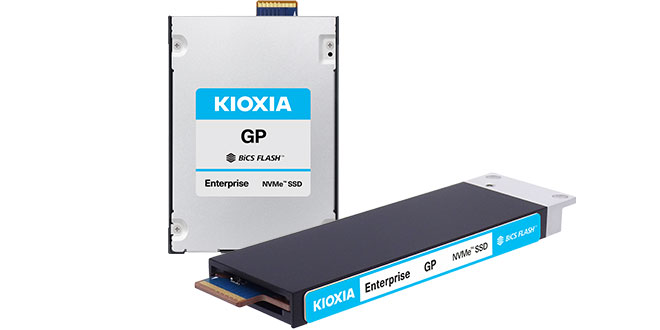
KIOXIA GP Series
KIOXIA has named this Super High IOPS SSD product the KIOXIA GP Series. The first generation product of the KIOXIA GP Series is developed to the PCIe® 6.0 standard and the second generation product is targeted at a PCIe® 7.0 generation intercept to achieve 100 MIOPS.
Innovation Shaping the Future of AI
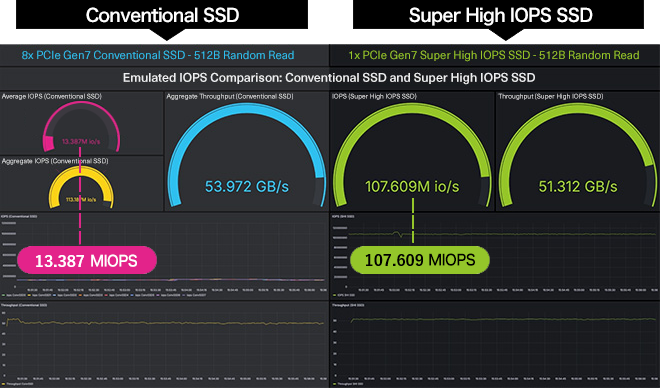
KIOXIA has reached the first milestone on this exciting product development journey in the form of the 100 MIOPS emulator. The emulator display shows the performance of the currently running GPU I/O. While a conventional SSD on the far left has a performance of around 13 MIOPS, the performance of the emulated Super High IOPS SSD (the third graph from the left) exceeds 107 MIOPS. This technology enables developers to have early access to a target device that can help them prepare their software stacks to take full advantage of the unprecedented speed that a Super High IOPS SSD unleashes. KIOXIA plans to begin sample shipments of its first generation products in the KIOXIA GP Series in late 2026, with an expected second generation release sometime in 2027.
- Product image may represent a design model.
- The product release plan is based on information as of April 2026, and the product specification and the schedule is subject to change without notice.
- Actual read and write speeds may vary depending on the host device, read and write conditions, and file size.
- NVMe is a registered or unregistered mark of NVM Express, Inc. in the United States and other countries.
- NVIDIA Storage-Next is a trademark and/or registered trademark of NVIDIA Corporation in the U.S. and other countries.
- PCIe is a registered trademark of PCI-SIG.
- Other company names, product names and service names may be trademarks of third-party companies.
Share


Data storage and memory technologies are essential for high performance generative AI systems. Kioxia has a long-term commitment to advancing AI through industry contributions of research and development in flash memory, SSDs, and associated technologies.
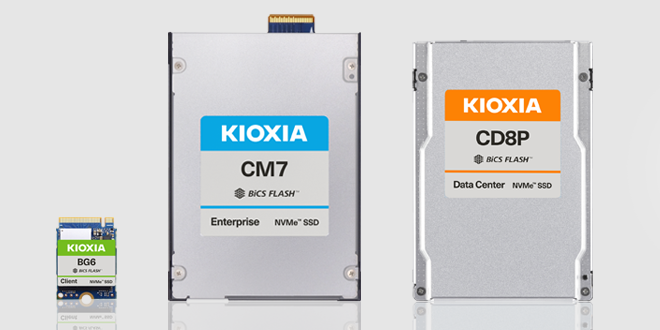
KIOXIA solid state drive (SSD) portfolio is built with BiCS FLASH™ 3D flash memory, delivering optimized SSD products and solutions for client PCs, enterprise servers and storage, and cloud data centers.
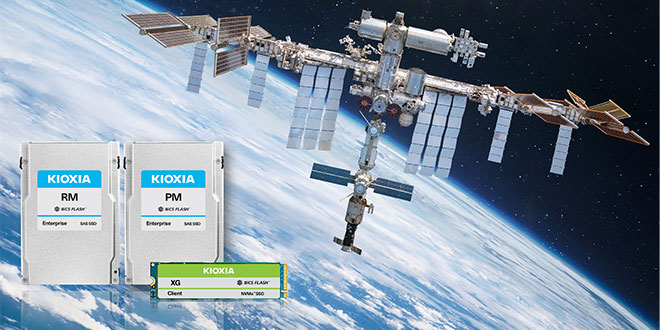
KIOXIA is participating in the Spaceborne Computer-2 (SBC-2) program with Hewlett Packard Enterprise (HPE), built with commercial off-the-shelf technology. The SBC-2 brings the first commercial edge computing and AI-enabled system to the ISS for in-space exploration, and to conduct a variety of experiments in space.